
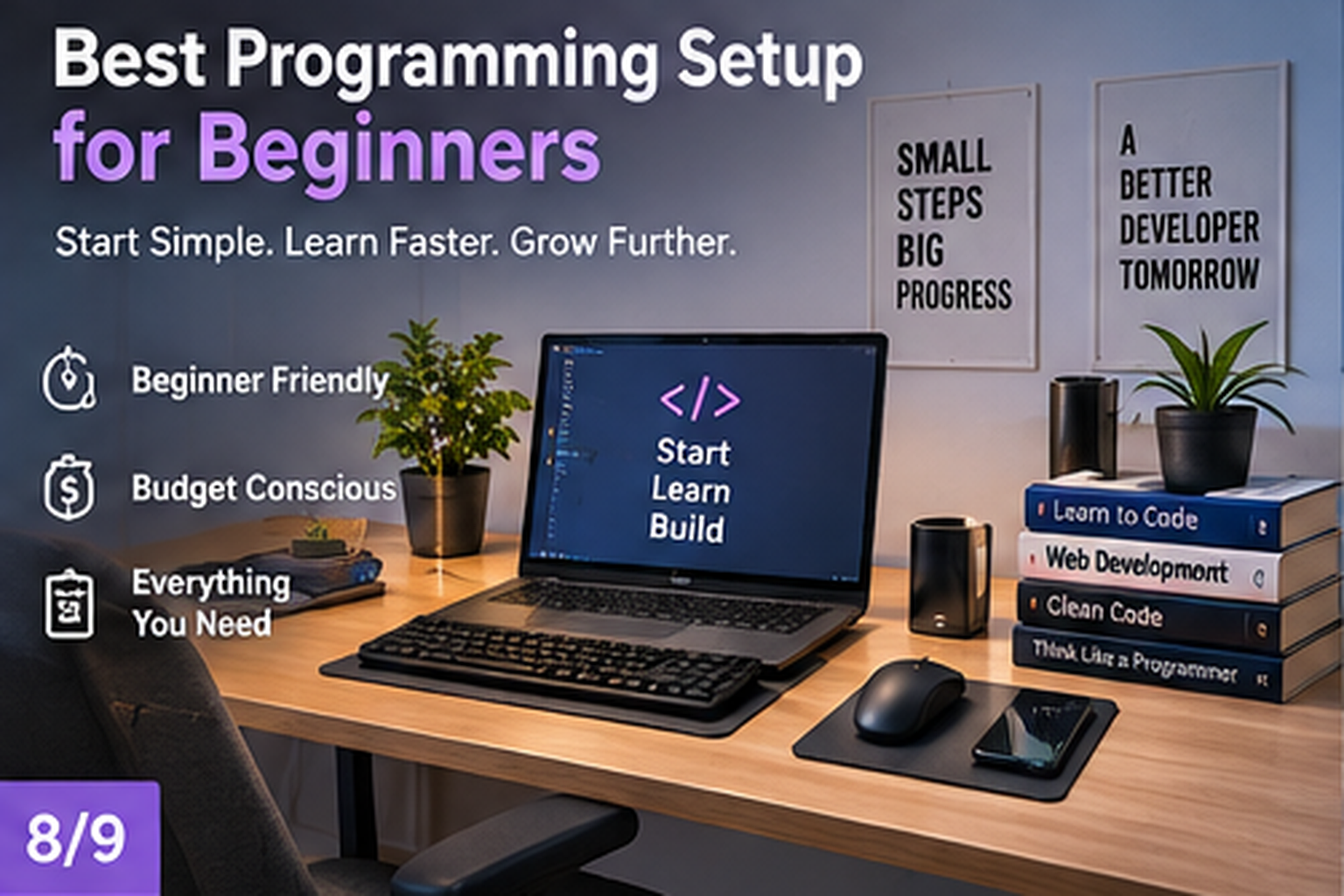
A productive workstation needs dependable tools and comfortable positioning. This guide focuses on student or first-time programmers doing small projects, VS Code or another editor, basic Git, a terminal, web browser, and introductory databases. Recommendations are research-based, not hands-on tests.
Recommended Setup at a Glance
Target user: Student or first-time programmer. Typical tasks: small projects, VS Code or another editor, basic Git, a terminal, web browser, and introductory databases. Core approach: use a capable existing computer, a clearly positioned display, a supportive chair, and only the peripherals you actually need.
Suggested computer: start with a working laptop or desktop, SSD preferred; 8 GB can support lighter work, while 16 GB gives more breathing room. Suggested display: the built-in laptop screen initially, followed by an affordable 24-inch monitor when needed. Workflow layout: a stable desk, an adjustable chair, and an external keyboard and mouse if the laptop is raised. Budgets are US-dollar examples excluding taxes and computers.
Core Hardware
Start with the machine you already own. For student or first-time programmers, the correct specification depends on how many local services, browser tabs, and development tools run simultaneously. As a practical guideline, 16 GB RAM and SSD storage are comfortable targets for many professional workflows, while lighter beginners may manage with less.
For displays, choose the built-in laptop screen initially, followed by an affordable 24-inch monitor when needed. Prioritize readable text and keep tested backups.
Where relevant, run small projects, VS Code or another editor, basic Git, a terminal, web browser, and introductory databases. Upgrade only for observed slowdowns.
Desk and Ergonomics
Choose a stable desk deep enough for the monitor, keyboard, and forearms without pushing the screen uncomfortably close. The IKEA LAGKAPTEN/ADILS 47¼-by-23⅝-inch desk was listed at $59.99 on the US manufacturer site during this research. Check load and mounting restrictions.
The IKEA FLINTAN chair was listed at $99.99 and has a mesh back, washable cover, and a 10-year limited warranty; its armrest variant was listed at $119.99. Adjust the chair to your body and keep input devices within easy reach.
Position the primary screen approximately at a comfortable arm’s-length viewing distance and adjust height to avoid sustained neck extension. Take regular movement breaks: a chair, however costly, is not a substitute for movement. For this use case, a stable desk, an adjustable chair, and an external keyboard and mouse if the laptop is raised.
Audio, Video, and Meetings
For most developers, a basic laptop webcam is sufficient for occasional internal calls when lighting is adequate. Add a dedicated headset when you share a room, work near traffic noise, or attend frequent client meetings.
Place a small light in front of or beside the face instead of behind the head, and use an uncluttered screen-sharing desktop. A standalone webcam is worthwhile if the existing camera looks poor in actual meeting conditions, not merely because a premium model exists.
Connectivity and Cable Management
The main requirement is predictable connectivity: existing Wi-Fi is sufficient for many beginner projects; use cloud version control plus local backups. Confirm that the host laptop port actually supports video output and the required USB-C Power Delivery level before purchasing a hub or dock. USB-C shape alone does not guarantee video or charging support.
Route the power cable separately from the mouse area, leave a service loop for adjustable-height desks, and secure excess lengths with reusable hook-and-loop ties. Keep power strips safely accessible; label cables.
Budget Breakdown
Budget assumptions: Start with equipment you own. Optional additions: desk about $60, basic chair about $100, keyboard and mouse $30–$60, lamp $20–$35, and later monitor $100–$160. A gradual upgrade costs about $210–$415, excluding the computer and taxes.
Manufacturer-verified reference prices during preparation were $59.99 for the IKEA LAGKAPTEN/ADILS desk, $99.99 for the IKEA FLINTAN chair, and $119.99 for the armrest version. Other figures are explicitly designated shopping allowances and are not current verified retailer offers.
To stay within a limit, keep a spreadsheet of actual checkout prices. Do not add a laptop or desktop cost to an accessory-only budget without updating the headline amount. Prioritize replacement of the weakest component first; an uncomfortable chair or unreadable screen can outweigh a faster decorative keyboard.
Why This Setup Works
Beginner learning priorities: Beginners benefit from fewer distractions. Install an editor, Git, language runtime, and one browser before adding extra devices. Keep a notebook for command-line mistakes and project ideas. Practice committing work and restoring files. Two displays can be helpful later, but they do not replace building small programs, testing assumptions, or reading error messages carefully.
The key benefit is workflow continuity. A defined place for coding, documentation, browser testing, and communication reduces repeated window rearrangement. Better screen positioning and a chair that fits make long sessions easier to manage, while organized cables make failures simpler to isolate.
Performance is not only benchmark speed. Waiting on a slow local database, searching for a missing power adapter, or constantly reconnecting a flaky hub interrupts concentration. Optimize the actual bottleneck you observe. Work in shorter sessions with planned movement and lighting changes instead of expecting furniture to eliminate fatigue.
Upgrade Path
First upgrade: solve the actual bottleneck: insufficient RAM, unreadable display, or poor chair fit.
Next upgrades: improve inputs and lighting; add a dock or storage only when needed.
Preserve receipts, compare warranties by region, and check that a replacement item fits desk dimensions and available power. An incremental approach protects cash and reduces duplicate accessories.
FAQ
Is one monitor enough for this setup?
Yes. Yes. Use virtual desktops, adding a second screen only when needed.
How much RAM do I need?
It depends on the tools and number of services running. For common professional workloads 16 GB is a useful target; 32 GB can help with extensive containers or virtual machines.
Do I need a standing desk?
No. A stable, correctly sized desk works well.
Should I buy a hub or docking station?
Only after verifying laptop ports and peripheral requirements.
What purchase improves the workspace first?
Fix the problem that occurs daily: poor chair fit, unreadable display, unreliable network, or slow storage. That typically yields more practical value than decorative upgrades.
Final Recommendation
For student or first-time programmers, start with the built-in laptop screen initially, followed by an affordable 24-inch monitor when needed and a computer that comfortably handles the actual workload. Keep the chair adjustable, the desk stable, and the cables accessible. Spend on what improves real sessions rather than chasing an idealized influencer setup.
Editorial disclosure and limitations: This is a research-based equipment plan, not a hands-on test of every product. Prices are US reference listings or explicitly labeled hypothetical allowances. Independently verify product dimensions, regional warranty coverage, compatibility, stock, and affiliate URLs before publication. No affiliate link has been inserted.


